Update: BossKitty Tweets as akaXochi daily
My personal observation: America has been hijacked by both extremes: selfish and self serving right and the selfish and self serving left . Where am I? I tweet when I’m riled up. I am disappointed in both of America’s political parties.
My statement has generated criticism mostly from the left. I am a progressive that sees little or no progress on either side.
What does align me with the left is Compassion for fellow Earthly life forms. Today’s Worldwide shift toward Authoritarianism and Fascism is terrifying. History is repeating.
Dehumanizing a class of people is the most vicious tool any leader will use to foment the hate that gives him dictatorial powers.
Today’s charismatic leaders are creating diasporas worldwide without concern for the consequences to the Planet or it’s occupants.
War is profit for a few, devastation for many. Earth is a finite and fragile ecosystem that has it’s own disruptions and tantrums. Humans ignore the injuries they inflict on Earth’s ability to sustain life at all.
For the remainder of 2018 America’s politicians will take to media to bash ‘the other side’ and demonize people for where they were born or what color they are. My grandfather taught me that those who holler loudest are the most guilty. I have seen this to be true.
If you are alive, can read, are engaged with those around you, don’t be fooled by mere words. Watch the actions of candidates. See their history of behavior. Decide at the ballot box who will most protect you from future chaos in your life.
Hate is a social cancer used by Dictators as a tool to justify selfish, dangerous behavior. I don’t want to live in George Orwell’s nightmare or Hitler’s Germany or Mussolini’s Italy or Trump’s America.
America’s Disappointing Role Models
The Tsunami of America’s Fallen Angels is drowning us. Shame is now a way of life and no longer as shocking as it should be. The shock has worn off because America has become desensitized.
America’s high profile role models have betrayed all of us … especially the children. There is no shortage of genuine role models, but those in our face every day have fallen from grace.
Immature Hollywood characters and sports figures are to be expected. Immaturity, arrogance, and special privilege is exposed to us a daily basis … but, not always from the usual suspects.
Judges, Mayors, Congresspeople, Senators, Religious Leaders and Military figures are redefining Truth, Honor and Honesty in America.
Honesty is the primary victim, accountability is lost in the noise and integrity is not profitable anymore. How do we teach our children to be honest? How do we convince our children to be truthful and honest?
Politicians, judges, prosecutors and policeman look out for each other, while they lock up the everyday citizens for anything from the trivial to the atrocious. If they make us all look like criminals, their indiscretions don’t appear as damning. Can they control and threaten us to stop the questions we ask? The latest round of Role Models crashing around us include sports figures, politicians, judges and various celebrities. They lie, they cheat, they steal, they commit sexual crimes … They deny over and over and over … only to look like cartoon characters once they are finally nailed to the wall with overwhelming evidence.
The most disgusting aspect of all this, is the damage to those who dare speak the truth. Some ‘TruthHuggers’ are blasted, bruised and discredited by high profile criminals protecting their advantages of celebrity and wealth. This is the legacy America is leaving to it’s children.
Certainly, there are local heroes, who stretch their capabilities to help individuals and their communities. But, sadly, there are fewer and fewer state or national heroes that are infallible. These high profile celebrities, politicians, clerics, sports figures and judges are crashing all around us.
Superman would have to change his motto from “Truth, Justice and the American Way”, to “Our Way or No Way” or “America, the land of the Free to Lie, Cheat and Steal …” The world watches America’s headlines and judges us as not trustworthy. Our children learn from us and figure out better ways to Lie, Cheat and Steal.
Lets not make a list of the fallen role models … too depressing.
Of Course It’s Not Just Guns
On Wednesday, January 16, 2013 – President Obama announced 23 Executive orders moving toward a more responsible environment surrounding Gun Control for Military  Assault Weapons. Finally, recognizing that comprehensive background checks are necessary to REDUCE the availability of firearms in the hands of people who could or would misuse those firearms. The NRA has taken their opportunity to exercise it’s 1st Amendment rights to condemn ANY responsibility applied to their sponsors.
Obama unveils sweeping plan to battle gun violence
NRA is sponsored by a Multi-Billion Dollar Industry that profits from purchases of Military Weapons and profits from armed conflict and from Drug Cartels. These weapons manufacturers supply the ordinary citizen PLUS Armed Militias, Drug Cartels and Terrorists (by proxy … of course). This industry really has no interest in any reasons for conflicts or consequences, they just know that’s where the money is! It’s always about the money.
In America, the weapons industry is funding NRA attacks on President Obama. NRA resents applying the word RESPONSIBILITY applied to gun ownership. President acknowledges the rights of responsible gun owners, hunters, sports and collectors. What the President did NOT say is that America’s Armed Militias will ultimately become Domestic Terrorists … again, NRA, the front for the weapons industry, wants to distract the public from THAT reality.
There are currently 114 Gun Manufacturers in America according to WIKI: Firearms manufacturers in the United States
NRA and the Weapons Industry has recruited a lot of voices to plug their message that ANY gun control is a THREAT! Oregon Sheriff Vows He Will Not Enforce ‘Unconstitutional’ New Gun Control Legislation, and Gun Advocate Larry Pratt Defends NRA Attack Ad: ‘Spot On’ In Proving Obama ‘Hypocrisy’
After the Aurora Theater massacre in July 2012, Forbes article: The NRA Industrial Complex – … the key to gun industry growth in the last few years is the NRA’s effort to scare gun owners and stop President Obama from being re-elected. NRA’s power comes from the way it spends money to reward politicians, who turn its self-interest into the law of the land and use its money and power to defeat politicians who oppose its will. Guns are an essential ingredient in senseless mass murders like the one in Aurora. And gun industry money is similarly vital to stifling anyone who dares discuss changes in the law that would keep Rugers and Glocks out of the hands of lunatics like Holmes, Loughner, and Cho. –
After Sandy Hook Elementary school massacre in December 2012, Forbes article: The Gun Industry Needs to Reinvent Itself Before It’s Too Late
The Atlantic: The Struggle Over Gun Control in Congress Begins With These Two Men
There is incomplete data for the average for gun related deaths a day in America, including suicides. There is a gap in reporting consistency to follow the actual figures as they happen. Not all gun deaths are as spectacular as the recent massacres America has suffered recently.
CNN: Analysis: Why gun controls are off the agenda in America
The FBI reported a record-high 2.8 million background checks for gun purchases in December, up from 2 million in November and 1.9 million from December 2011. Mr. Obama said law-abiding gun owners shouldn’t fear his proposals, due later this week, which he said are only designed to prevent mass shootings such as last month’s rampage at Sandy Hook Elementary School in Newtown, Conn.
THE CHART
Provided by Dr. David Healy, “Welcome to Data Based Medicine”
| What | Drug | Date | Where | Additional |
| School Shooting | Prozac WITHDRAWAL | 2008-02-15 | Illinois | ** 6 Dead: 15 Wounded: Perpetrator Was in Withdrawal from Med & Acting Erratically |
| School Shooting | Prozac Antidepressant | 2005-03-24 | Minnesota | **10 Dead: 7 Wounded: Dosage Increased One Week before Rampage |
| School Shooting | Paxil [Seroxat] Antidepressant | 2001-03-10 | Pennsylvania | **14 Year Old GIRL Shoots & Wounds Classmate at Catholic School |
| School Shooting | Zoloft Antidepressant & ADHD Med | 2011-07-11 | Alabama | **14 Year Old Kills Fellow Middle School Student |
| School Shooting | Zoloft Antidepressant | 1995-10-12 | South Carolina | **15 Year Old Shoots Two Teachers, Killing One: Then Kills Himself |
| School Shooting | Med For Depression | 2009-03-13 | Germany | **16 Dead Including Shooter: Antidepressant Use: Shooter in Treatment For Depression |
| School Hostage Situation | Med For Depression | 2010-12-15 | France | **17 Year Old with Sword Holds 20 Children & Teacher Hostage |
Dr. David Healy, author of The Antidepressant Era, Let Them Eat Prozac, and ‘Pharmageddon, did a lot of research to create a comprehensive chart of cause and effect of antidepressants and violence in America. Even though this chart list is very incomplete, it does illustrate the predominant connection to a greater formula for disaster, here in America. It is a formula that cannot be stopped easily. Endangering society to reap financial profit is criminal! Among those profiting from the combination of Drugs, Weapons and Disinformation is Doctors, Lawyers, Gun Manufacturers, Drug Manufacturers, Hollywood, Anarchists and Armageddon Advocates.
Our Personalities Are Constantly Changing, Even if We Think They’re Not
The sad reality about untreated and misunderstood mental conditions is the stigma associated with mental illness, and society’s knee jerk responses to anyone seeking mental health help. So a far larger proportion of mass homicides, including the brutal July 2011 attacks in Norway, the Tucson, Ariz., shooting that wounded Congresswoman Gabby Giffords and the Virginia Tech massacre in 2007, involve perpetrators with mental illness. The proportion far outstrips the rates of mental illness in the population.
Here are some very informative articles addressing the facts surrounding the Gun issue:
Gun Rhetoric vs. Gun Facts
Crime Statistics > Murders (per capita) (most recent) by country
Crime Statistics > Murders with firearms (most recent) by country
I have tried to make such a list for a long time. 2/3 of the murders in the United States are committed with guns, and all of these mass killings, except for September 11, 2001 and the Alfred P. Murrah Federal Building in Oklahoma, have been done with guns. It was only dumb luck that the man who crashed his plane into a Texas I.R.S. Office, did not have more fatalities. It is VERY true that guns are not the only culprit … if someone wants to commit murder and mayhem, they will use whatever they know how to use … or whatever is most convenient. Guns are the easiest to get.
The massacre of 77 people in Norway was an exception, because there is little history of gun violence in Norway because of strict gun laws. Breivik also bombed government buildings on Oslo. America has mass gun violence almost on a daily basis. Seldom do these atrocities get media attention in America, unless it is at a School, Mall or Movie Theater. America is riveted to the spectacular and is drawn to screaming media coverage.
The numbers would be even more incredible if you include local incidents that have fewer victims to warrant a news story. The reality that a perfectly normal acting person can be really ACTING NORMAL. No one knows the true feelings of someone who has a deep down perception of paranoia, rejection or damaged self esteem igniting a desire for revenge. Human Mental Health changes on a daily basis … someone can snap at a moment’s notice. Witness all the workplace and Domestic violence … people can use anything to kill another human being. But, guns are the easiest weapon.
Mental state (Health Care) + Altered state (Drugs) + availability of Deadly ‘Toys’ (Weapons)= Atrocity
No, of course it’s not the gun’s fault. It’s the diminishing human capacity to be accountable for their actions and consider the consequences. Crazy people have easy access to guns. Stupid people don’t want to prevent that. Stupid people want to associate any gun possession responsibilities with attacks on our 300+ year old Constitution, that reflected the desires of America’s Founding Fathers in the 1700s.
If America’s Founding Fathers could see us now, 300+ years later … what do you think their priorities would be? Given the technology advancements to all things America, our Founding Fathers would obviously have worded the Second Amendment a little differently. Yes, America wants the ability to overthrow a disagreeable government. Do you really think that is feasible? Don’t you think that the government’s technology can overwhelm anything some anarchist can use? Military weapons in the hands of civilians only allows some sick minded ass-hole to commit mass murders of innocent people. Even your ordinary murderer uses more practical, personal weapons that mostly target their chosen victim. They usually don’t wipe out a whole neighborhood, school or mall to dispatch their evil spouse or evil co-worker.
Military weapons are mass human killing machines and it would be ridiculous to imagine hunting a deer or duck with one. There would be too little left to eat! GET REAL!
Even more important is that too many Modern Americans have lost the ability to identify with other REAL human beings. Modern social interaction has become ‘Wireless’ and ‘Remote’ and hands off. Self esteem is becoming more and more dependent on devices that connect people remotely. Social disconnect along with the sensory assault by violent media, marketing the thrill of violence, has changed how modern society perceives each other.
There are acceptable illnesses and unacceptable illnesses. Cancer and Heart Disease are the most socially acceptable illnesses, Mental Illness is whispered and socially unacceptable. However, Mental Illness is the gold mine for pharmaceuticals … the caveat is always the MONEY! Insurance Industry and Affordable Health Care have payment limits. When those limits are met, the patient is left to their own devices without those costly pharmaceuticals that keep them stabilized. Eventually the patient is released to family or the streets … until their benefits reset. That wait, that interruption in treatment, usually results in disaster.
Inadequate oversight and negligence go hand in hand. Endangering society to reap financial profit is criminal! Inadequate oversight is criminal, because it endangers everyone. This is what America has evolved into … exploitation at the cost of health and safety.
Because most people dislike or distrust government, no one wants government to have any control over anything … including our own well being. There are a great number of Americans who are totally dependent on government assistance … and NO they are NOT all leaches and blood suckers who scam the system because they are lazy bums. Many of them have legitimate illness or age related issues that prevent them from supporting themselves. Some day you will grow old, too … as long as you survive the ailments provided by modern technology.
There is deliberate inadequate, ineffective oversight concerning the Pharmaceutical Industry. The FDA is not funded to do it’s own testing to verify new drugs or new uses are safe. FDA has to let the fox report on the chickens. The results ALWAYS sound too good to be true. Besides, a LOT of MONEY is riding on a positive result. And, everyone knows in advance that Pharma Corporations own enough Congressmen and Senators to get past thorough oversight.
There is inadequate responsibility for mental health in America. Mental Health is a critical part of the HEALTH Industry. A LOT of Americans don’t trust the HEALTH Industry and don’t want anyone questioning their MENTAL HEALTH. Mental Health has been demonized and whispered about for over a century in America. Nothing can ever happen unless there is a willingness to participate. America does not have the guts to participate in genuine mental health diagnosis or treatment. Those that do are exposed to the Big Pharma/Health Care/Insurance three headed Mafia.
Don’t forget we are human and if we are healthy and socially functional, we have the ability to recognize our options. Those who ‘snap’ cannot see any options. So they act out their frustrations or imaginary fears. Some mentally ill can see no other courses of action available … the consequences of their actions are no longer important. Undiagnosed Mental Health issues are America’s Armageddon. They remain untreated. ~^^~
The finger pointing is not that convenient. It is a systematic failure that puts deadly ‘toys’ in the hands of people who should not have them. It is a formula … as you can see on Dr Healy’s Chart.
These don’t just happen in schools. I wrote an article about an example here in Austin, a guy off his meds got hold of a gun and killed an actor.
America’s mental state needs to be addressed, but that will never happen under the current corporate leadership. Corporations have figured out how to profit from these atrocities. More drugs, more guns, more sick people not being diagnosed or treated.
I repeat: Among those profiting from the combination of Drugs, Weapons and Disinformation is Doctors, Lawyers, Gun Manufacturers, Drug Manufacturers, Hollywood, Anarchists and Armageddon Advocates.
The term “drug wars” often refers to violent cartels which bully, bribe and slaughter in the name of illegal drug profits. But another drug war is assailing America, and no machine guns are used. Rather, it’s a war inflicted by huge pharmaceutical companies — often foreign-based — which knowingly sell deadly, defective drugs for years while reaping monstrous profits. ~ Jim Adler.
So, profiteers are on a roll as long as they can keep America’s Mental Health on tilt.
How Overconfidence and Paranoia Become Self-Fulfilling Prophecies
It would be interesting to look at extremist militia groups, regarding paranoia and self-fulfilling prophecies, especially in light of the current revival of interest in gun control issues. It seems to me that such groups who fear that the government (or UN stormtroopers) will come to take away their guns and so create groups that practice paramilitary training and hoard firearms are creating exactly the conditions that will draw the attention of law enforcement. The more radicalized their speech and practices become, the more likely it would be that government agencies would be informed and investigate or seek informants to monitor such groups. In their minds, this would seem to confirm their paranoid visions of a police state out to squash 2nd Amendment rights and free speech. ~ sk3
Drop the script written by bitter old men!
OMG the Sunday Morning talk shows got to me again! America’s politics is nothing but a script written by bitter old men! Who are these bitter old men? Are they the Republicans who have been in politics for a very long time? Unlike younger Republicans, they have not updated their political stances in the last couple of decades and are less willing to compromise than their more youthful and practical counterparts. The problem with the “Old Guard” is that they are entrenched and are “owned” by special interests. Old Guard on both sides are polar opposites and operational governance is at a standstill!
Ah, the BRICK WALL of RHETORIC.
The CLASH of brick walls is destruction. Brick Walls crush each other because they are rigid. Rigid is great until it runs in to another rigid Brick Wall. The history of human civilizations is paved with crushed walls! Many times these crushed walls are no longer recognizable, because they have turned to dust and rubble. America’s politics is quickly turning into dust and rubble! The American Culture has morphed into the typical formula that “crushed” so many ancient civilizations and is no longer recognizable as the dream of it’s Founding Fathers.
Mitch McConnell is guilty of assuming he knows what a whole, diverse group of people, think, feel and will act. “All the Democrats want to do is spend”. “The Debt Ceiling is a hostage worth ransoming”. So, McConnell’s oath to Grover Norquist appears to supersede his oath to America! Any proposals by the Democrats and President Obama is poison to “Old Guard” handlers. The Senate Minority Leader deliberately does not put names and faces on the population he wants to cut loose fro those “DIRTY ENTITLEMENTS”, which happen to be everything described in the US Constitution. The balancing act between government responsibility to it’s people and it’s lenders has become heavy handed on the scale. One side wants the other side to be responsible for everything. That argument can be pointed in both directions.
But, of course, the OTHER side is just as guilty of painting a radical picture of their opponents. All Republicans want to do is exclude the disadvantaged. All Republicans want to do is protect rich corporations from accountability or liability. NO ONE considers cause and effect, no one considers the consequences of excluding ALL the rich or ALL the poor. No one addresses what has caused disadvantage in the first place …
George Will argued with Robert Reich, that in order to have the welfare state he said Reich and other liberals want, the Bush tax rates on the middle class would have had to been rolled back, taking the entitlement state off the table.
 a state the liberals want, the entitlement state without taxing the middle class at least. And now you’ve given up that with the locking in as permanent law the Bush tax rates — that’s off the table.”
No one seems interested in Cause and Effect … what causes the mess we are in and how do we reverse the trend. If it is really reversible. America is drowning in the Economics of Poverty while it wants to throw all the consequences overboard to lighten the load for what is seen as the “Captains” on America’s lifeboat. Luxuries enjoyed by the wealthy are provided by poorly paid servers. If they throw them all overboard, there will be no one to row the boat.
I propose that “Both Sides” be required to work in the SAME ROOM and talk to EACH OTHER. Lay out all the issues each representative is faced with and tasked to do by their constituents.
I propose that the “Old Guard” be required to admit that the population of America has grown and the Baby Boomers are entering the “entitlement” phase of their lives. They have paid in to the “Safety Net” system put in place with Social Security and Medicare. BossKitty paid Social Security and Medicare taxes for almost 50 years. That is NOT an entitlement, it was an investment!
It appears that the Right Wing Brick Wall has confused the definitions! Social Safety Net vs. SocioEconomic Safety Net! The Brick Wall Tea Party dogma: No Taxes? No Deals? No Compromises! No nothin! Period. The Right Wing Brick Wall cannot consider the dangers of excluding the poorest from their ability to climb out of their poverty. The misconception the Tea Party has is that these “Blood Suckers” enjoy the free services and enjoy their “poverty” entitlements.
Listening to Newt Gingrich, on Sunday Morning Meet The Press Roundtable, shocked me by making a LOT of sense. Newt explained the whole Sandy Relief debacle in the House of Representatives. Why was there no media coverage about the extra “Pork” added to the Disaster Relief bill that had NO relevance to Hurricane Sandy Victims!
Why do these guys sound so good and logical when they are no longer pandering to their owners? When they are separated from their handlers, they are really just people. When they are in Campaign Mode, they are nothing but ROBOTS!..
This predisposition that another group is so dependable is great … in a cartoon world! This is where “Stereotypes” come from. So, let’s say I will always act this way … because YOU will always act THAT way! Therefore, I will never consider your points, because you will never consider my points. Tea Party dogma: No Taxes? No Deals? No Compromises! No nothin! Period.
Whether you know it or not, you are conveniently stashed into a social/political cubby hole. Which stereotype YOU fall in to? You will never know, because a team of analysts have decided who and what you are. They feed their findings into a computer and design their ideal political robot to grab your emotions … and vote!
Let’s quit NON-action rhetoric. Drop the SCRIPT written by bitter old men who are nothing more than ‘Front Men/Women’ for special interest lobbies!!!
The RHETORIC that Democrats are SOCIALISTS! Republicans are NAZIs! And, everyone else is irrelevant because they are poor, powerless and don’t know Jack Shit!
Some of the facts that are being run over and ignored by the Brick Walls in Congress:
Currently, an estimated 46.2 million Americans are in poverty. Nearly 44% of poor Americans are in “deep poverty,” meaning they subsist on below half the official poverty line. Median earnings for all Americans have consistently dropped for the past four decades, and inequality has exploded. Americans are working longer hours in worse jobs for less compensation. Socioeconomic mobility is on its way towards functional extinction. And needless to say, all of these trends are heavily stratified along racial lines. This is the status quo which Beltway progressivism is fighting to preserve, because it can only foresee a worse alternative.
As long as America fails to face the causes for all of it’s woes, toxic exposures to legal and illegal drugs, along with environmental pollution (water and soil), dysfunction will continue to accelerate America’s demise. America’s exposure to toxic substances have made us sicker and richer at the same time. America has sold this formula to other countries and cultures, so this shared disaster is an epidemic. The dysfunction is America’s inability to reduce toxic exposure because it is addicted to the money it brings in. This is the same business model of illegal drug cartels. It is nothing more than a money model. America’s version of this same model is more palatable because it makes it’s citizens believe they are participating in the decision making. When the citizens start suffering from the ill effects of reality, they are fed the placebo of a target group to blame. This is where the dysfunction reaches it’s peak and ordinary citizens start acting out and committing atrocities against each other. The clueless Washington Political Machine continues to play the same script and ignore the consequences of dismissing the causes for poverty and disability that has clogged America’s economic system.
War on Kwanzaa
This is absolutely remarkable that this neanderthal Republican publicly stated this nonsense. No wonder that Tea-Publicans are so clueless. They have been brainwashed by Fox and Koch and all the Corporate Jesus wannabes. WWJD?.
State Sen. Glenn Grothman Declares War on Kwanzaa
The West Bend Republican calls for an end to Kwanzaa, which he describes as a fake holiday aimed at dividing blacks and whites.

GOP State Senator: Kwanzaa Is A Leftist Plot ‘To Destroy’ America
While outrage about the so-called war on Christmas has died down for another year, Wisconsin state Senator Glenn Grothman (R) has launched a new war on Kwanzaa, claiming it is a fake holiday invented by racist radicals who want to “divide America.”
In a press release entitled “Why Must We Still Hear About Kwanzaa,” Grothman ranted that Kwanzaa is a holiday celebrated by “left wing nuts” because “they don’t like America and seek to destroy it.” Grothman is comforted by his belief that “almost all black people ignore” Kwanzaa, but is deeply troubled by the fact that schools are teaching the holiday:
Irresponsible public school districts such as Green Bay and Madison (and who knows how many others…) try to tell a new generation that blacks have a separate holiday than Christians…But why do they do it? They don’t like America and seek to destroy it by pretending that its values as expressed in the Declaration of Independence and our Constitution, don’t apply to everyone. Mainstream Americans must be more outspoken on this issue. It’s time it’s slapped down once and for all…Be on the lookout if a K-12 or college teacher tries to tell your children or grandchildren it’s a real holiday.
Oh My! Kwanzaa started by Maulana Karenga who said his goal was to “give Blacks an alternative to the existing holiday and give Blacks an opportunity to celebrate themselves and their history, rather than simply imitate the practice of the dominant society.” … as Kwanzaa gained mainstream adherents, Karenga altered his position so that practicing Christians would not be alienated, then stating in the 1997 Kwanzaa: A Celebration of Family, Community, and Culture, “Kwanzaa was not created to give people an alternative to their own religion or religious holiday.”[5] Many Christian African Americans who celebrate Kwanzaa do so in addition to observing Christmas.[6]

WIKI: Kwanzaa is a week-long celebration held in the United States (and, more recently, Canada) but also celebrated in the WesternAfrican Diaspora. The celebration honors African heritage in African-American culture, and is observed from December 26 to January 1, culminating in a feast and gift-giving.[1] Kwanzaa has seven core principles (Nguzo Saba): Unity, self-determination, collective work and responsibility, cooperative economics, purpose, creativity, and faith. It was created by Maulana Karenga, and was first celebrated in 1966–67.

TPA’s Texans of the Year are the Tar Sands Blockaders

“As with previous winners (like Fort Worth city council member Joel Burns in 2010, the Harris County Democratic Party’s coordinated campaign in 2008, and Carolyn Boyle of Texas Parent PAC in 2006), the Tar Sands Blockaders represent what progressive Texans strive for: correcting injustices through direct action. Sometime that takes place at the ballot box, sometimes in the courtroom, and once in a while it happens in the streets. In 2012, it happened in a handful of pine trees in East Texas,” said Vince Leibowitz, president of the TPA.
The Tar Sands Blockade began when TransCanada, the pipeline company constructing the southern leg of the Keystone XL pipeline, began seizing property from East Texans via eminent domain to connect the pipeline, which will transport tar sands oil from Canada to refineries in Houston and Port Arthur. Despite the fact that the pipeline hasn’t yet been approved by the US Department of State, TransCanada and other operators have been busily cutting down swaths of forest, appropriating the land along the route as necessary, and when challenged by the small group of people protesting, responded with threatening measures and occasionally brute force.
When petitioning, lobbying, and public hearings failed to slow the construction of the pipeline, concerned citizens took to non-violent protests, risking arrest in order to demonstrate the will and demands of Texans concerned about the environment, about the nation’s continuing dependence on dirty fuels, and the collaboration of government officials with the corporate interests. A group of protestors climbed into a stand constructed in a grove of pine trees and halted construction for weeks.
The movement began in June of 2012 with the formation of the Tar Sands Blockade, and the first lawsuit was filed in July.
As construction began in August, protestors began putting themselves on the line. Seven protestors were arrested in Livingston, Texas just before the Labor Day holiday. Even as a judge allowed TransCanada to seize a swath of farmland in Paris, Texas, more protestors chained themselves to construction equipment in rural Hopkins County.
The New York Times and the Washington Post picked up the story in October.
Along with the property owner, actress and activist Daryl Hannah was arrested as the two women physically blocked a piece of heavy equipment and its operator from clearing land for the pipeline. Even as the number of arrests climbed past thirty, the protests grew. A few days before the November election, Green Party presidential candidate Jill Stein was arrested at the construction site in Winnsboro. In Cherokee County, sheriff’s deputies pepper-sprayed protesters. All of this occurred while the legal battle went back and forth — in December, a judge granted, then vacated, his temporary restraining order on pipeline construction.
And the efforts to stop the pipeline continue today, even as pipeline construction proceeds apace. On November 29, Bob Lindsey and prominent environmental activist Diane Wilson were arrested by Harris County sheriff’s deputies outside Valero’s refinery in the Manchester neighborhood of Houston, where the pipeline will terminate. They chained themselves to tanker trucks outside the gates, were promptly taken into custody, and continue a hunger strike to this day that adds the humiliating and disgusting conditions of Harris County’s jail to the list of outrages.
With training and mobilization of additional protests and protestors scheduled for early January, 2013, there will be more to report on this action.
The Texas Progressive Alliance salutes those who have sacrificed so much of themselves to underscore the seriousness of America’s fossil fuel addiction, and how the system of corporate and political corruption has come to manifest itself in the controversy surrounding the Keystone XL pipeline.
Runners-up for this year’s Texan of the Year included the following…
— The emerging scandal of the Texas cancer research organization, CPRIT;
— The spectacular failure of Governor Rick Perry’s presidential campaign;
— Attorney General Greg Abbott’s woeful losing record in court in his many lawsuits related to the federal government, including redistricting, voter ID, Obamacare, etc.;
— Senator Wendy Davis of Fort Worth, who defied conventional wisdom and was re-elected to the Texas Senate despite the best efforts of Republicans to deny her;
— The expansion of the Texas Congressional delegation to 36 as a result of the 2010 census and apportionment of extra seats based on population growth in the Lone Star State. New Texans in Washington DC include former Democratic state representatives Pete Gallego and Marc Veazey, but also — and unfortunately — ultraconservatives Randy Weber and Steve Stockman.
Good Riddance 2012
WIKI: 2013
2013 (MMXIII) will be a common year starting on a Tuesday in the Gregorian calendar. It will be the 2013th year of the Common Era (CE) and Anno Domini (AD) designations; the 13th year of the 3rd millennium and the 21st century; and the 4th of the 2010s decade. It will also be the first year to be denoted by four different digits in 26 years (since 1987).
WHEW – 2013

2012 represents enough trauma to last a decade. Good riddance! We’ve had enough from the Apocalypse of emotional trauma.
Doggedly ignoring all the RETRO shows and commentary, I prefer to put the events and attitudes from 2012 into the bottom drawer and lock it shut. I know a lot of good things happened during 2012, but they remain a raindrop on my dirty windshield as I look forward to the road ahead. My mind is running those windshield wipers to remove the dirt and bugs away from my vision.
Natural and UNnatural disasters plagued 2012. The Mayan Calendar and Nostradamus have had their say. I’ve been taught to be careful with my water and stashed enough food and toilet paper for several weeks, if not months. Because, Mother Earth will continue with her cycles whether I’m prepared or not. So, I choose to be vigilant with my resources. My global disaster scenario is focused on what humans continue to do to humans in the name of some GOD or PROPHET or CORPORATION. I truly do NOT believe that anyone’s understanding of GOD would condone how his or her creations are behaving. I truly do NOT believe that anyone’s understanding of GOD would condone how those same human creations are treating the paradise designed to nurture and sustain them.
Do you really think that GOD has a stake in Wall Street?
Do you really think that GOD has a stake in Petroleum Products, Weapons Manufacture, Bigotry or Tea Parties or Venomous Clergy/Politicians?
Do you really think that GOD is pleased with the way humans have warped the intent of a Supreme Being?
I support the notion that 2013 is the pivotal year for humans to realize that their actions have consequences beyond their immediate understanding. With all the Doomsday marketing, the one good lesson is for humans to pay more attention to their surroundings and understand there is no mommy to follow them and clean up their mess … anymore. Hopefully, if everyone can take responsibility for their own actions, we can put accountability and action back into the same sentence … maybe accountability can go viral. Maybe cleanliness will return to our thoughts and actions and we can stop contaminating the same environment that allows us to live. Maybe we can stop plundering the remaining resources Mother Earth uses to feed, house and clothe us and start nurturing our planet back to life.
The Mayans and many civilizations that preceded us have lessons that we have ignored. Each of those crumbled civilizations missed something crucial to their survival through arrogance and distraction. Political and Religious head games replaced common sense necessary for survival.
The modern world, and Western Civilization especially, has hurt itself by distracting it’s children from the common sense and understanding of the world around them, and how it works. Western Education has replaced common sense, and the rules of cause and effect, with political and religious head games, with emphasis on technology. The technical world has blinded the human symbiotic relationship with planet earth. Our urban children have no clue where their Big Mac comes from. Rural children cannot relate to how crowded and fragile communities exist in large metropolitan cities.
This disconnect between urban and rural, with the dependence on high technological devices and systems, has driven a huge wedge between parts of western culture. We have no idea how stuff works or where it comes from, we just know we must have it …. Corporations plunder this disconnect and encourage misunderstandings so they can target their products to specific regions and mindsets. Industry makes sure that the voting public is under their control by buying politicians, paying for gerrymandering districts so the elections are predictable and the politicians are in their pockets.
The weapons industry depends on an armed society for their profit. The pharmaceutical industry depends on real or imagined ailments for their profit. The petroleum industry has the world by it’s balls, because no matter what alternative energy source is agreed upon, almost everything we use has a petroleum base in it’s manufacture.
Still, there is always something the individual can do. Look at the world around you, respect it. Learn how it works. Respect the world that allows you to live and breathe. Understand that you are not the only living organism in your own body. Everyone contains a host of living organisms inside them. Everyone is 70% fluid, containing bacteria, viruses, bodies and antibodies. Understand that polluted water changes the symbiotic nature of what we are made of. Symbiosis makes us human.
Without understanding how we work and how the earth works and how we can work together for mutual survival, 2013 will be a short year for all of us.
If you have never heard of GAIA, you may want to learn about it.
Gaia philosophy (named after Gaia, Greek goddess of the Earth) is a broadly inclusive term for related concepts that living organisms on a planet will affect the nature of their environment in order to make the environment more suitable for life. This set of theories holds that all organisms on a life-giving planet regulate the biosphere to the benefit of the whole. Gaia concept draws a connection between the survivability of a species (hence its evolutionary course) and its usefulness to the survival of other species.
 .
.
NRA Whack-A-Mole Questions
On Wednesday, January 16, 2013 – President Obama announced 23 Executive orders moving toward a more responsible environment surrounding Gun Control for Military Assault Weapons. Finally, recognizing that comprehensive background checks are necessary to REDUCE the availability of firearms in the hands of people who could or would misuse those firearms. The NRA has taken their opportunity to exercise it’s 1st Amendment rights to condemn ANY responsibility applied to their sponsors.
Obama unveils sweeping plan to battle gun violence
NRA is sponsored by a Multi-Billion Dollar Industry that profits from purchases of Military Weapons and profits from armed conflict and from Drug Cartels. These weapons manufacturers supply the ordinary citizen PLUS Armed Militias, Drug Cartels and Terrorists (by proxy … of course). This industry really has no interest in any reasons for conflicts or consequences, they just know that’s where the money is! It’s always about the money.
In America, the weapons industry is funding NRA attacks on President Obama. NRA resents applying the word RESPONSIBILITY applied to gun ownership. President acknowledges the rights of responsible gun owners, hunters, sports and collectors. What the President did NOT say is that America’s Armed Militias will ultimately become Domestic Terrorists … again, NRA, the front for the weapons industry, wants to distract the public from THAT reality.
There are currently 114 Gun Manufacturers in America according to WIKI: Firearms manufacturers in the United States
NRA and the Weapons Industry has recruited a lot of voices to plug their message that ANY gun control is a THREAT! Oregon Sheriff Vows He Will Not Enforce ‘Unconstitutional’ New Gun Control Legislation, and Gun Advocate Larry Pratt Defends NRA Attack Ad: ‘Spot On’ In Proving Obama ‘Hypocrisy’
After the Aurora Theater massacre in July 2012, Forbes article: The NRA Industrial Complex – … the key to gun industry growth in the last few years is the NRA’s effort to scare gun owners and stop President Obama from being re-elected. NRA’s power comes from the way it spends money to reward politicians, who turn its self-interest into the law of the land and use its money and power to defeat politicians who oppose its will. Guns are an essential ingredient in senseless mass murders like the one in Aurora. And gun industry money is similarly vital to stifling anyone who dares discuss changes in the law that would keep Rugers and Glocks out of the hands of lunatics like Holmes, Loughner, and Cho. –
After Sandy Hook Elementary school massacre in December 2012, Forbes article: The Gun Industry Needs to Reinvent Itself Before It’s Too Late
The Atlantic: The Struggle Over Gun Control in Congress Begins With These Two Men
There is incomplete data for the average for gun related deaths a day in America, including suicides. There is a gap in reporting consistency to follow the actual figures as they happen. Not all gun deaths are as spectacular as the recent massacres America has suffered recently.
CNN: Analysis: Why gun controls are off the agenda in America
The FBI reported a record-high 2.8 million background checks for gun purchases in December, up from 2 million in November and 1.9 million from December 2011. Mr. Obama said law-abiding gun owners shouldn’t fear his proposals, due later this week, which he said are only designed to prevent mass shootings such as last month’s rampage at Sandy Hook Elementary School in Newtown, Conn.
Sunday morning talk shows on 12/23/2012, were all about the NRA push back against any responsible decisions about guns and keeping them out of the WRONG hands.
NRA Whack-A-Mole solution to mass shootings falls short of common sense because those solutions are too simplistic and idealistic. Don’t tread on the 2nd Amendment …
Second Amendment – Militia (United States), Sovereign state, Right to keep and bear arms. A well regulated Militia, being necessary to the security of a free State, the right of the people to keep and bear Arms, shall not be infringed.[60]

NRA issues point-blank ‘no’ on gun control
NRA wants an armed America with no accountability, do you think our Founding Fathers anticipated this development? Is that really what the 2nd Amendment means?
Q – Who really has the WRONG HANDS? Who makes that decision and how fast can they do something about it?
Q – Who offers to FUND this very expensive effort … in a cash strapped America! Budget cuts threaten social programs everywhere. Republicans, i.e. Grover Norquist, refuse to consider higher taxes to pay for any government programs. However, emphasis remains on making sure that guns remain unregulated … no problem there, America’s regulations are a joke anyway. Congress won’t agree on funding. Regulations and Enforcement are VERY expensive, maybe the private sector? or maybe churches? Yeah, let’s make the churches fund all the programs our government doesn’t want to pay for. Let’s let industry keep on being irresponsible to the American Public by blasting us with advertisements showing how our lives will improve with their un-regulated products.
NRA offers NON-fundable solutions. NRA has not offered to fund their own solution to put armed armed GOOD GUYS in schools. Schools, and the entire education system in America, already suffers from cutbacks and de-funding because taxes for their support have fallen too low. So, school systems can’t pay for the NRA solution.
NRA wants teachers to have guns in their classrooms. NRA will pay for that! Bethcha NRA will fall short of training those same armed teachers to be ready for ALL the scenarios they may be faced with … Not 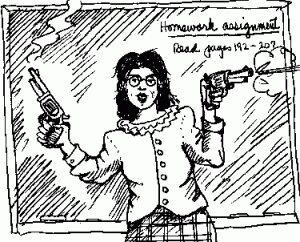 even Law Enforcement can anticipate ALL scenarios. Hmm, that makes me feel much better, armed teachers and janitors with inadequate training would improve student behavior, wouldn’t it? What if a teacher goes “Postal” …
NO follow through for any dreamlike NRA solutions have been offered.
The expense of monitoring and deciding who is Good and Bad would require a huge intrusion on personal rights concerning medical records. Isn’t that the 4th Amendment?
The Drug Industry wants everyone on THEIR drug … and the Weapons Industry wants a gun in every home because of the crazies on drugs … or off their drugs.
Ahhh, the mental health issue … Today’s mental health is decided by Marketing and Advertisement, from industry intent on controlling what the population should use or own to improve their social status … America blows this way and that by marketing winds. Americans must be convinced that purchasing stuff that is cleverly advertised will make them better Mothers, Fathers, popular in school and great in bed … but not always greater Citizens.
NRA President LaPierre is convinced that every gun related tragedy can be solved with more armed people. NRA guarantees more shootouts in our future …
More GOOD GUYS having shootouts with more BAD GUYS will make the public safer? Somewhere within this discussion something is missing …. what could that be?
Q – WHO decides which one is the GOOD GUY and BAD GUY???? What will it take to make that JUDGEMENT CALL and ENFORCE it? Isn’t there another Constitutional Amendment that would be violated if personal intrusion is used to determine Good and Bad?
Q – Who is paying for all this? Hire certified ARMED protection for (schools, malls) EVERYWHERE!
That’s just great! In this economy, that demonizes “ENTITLEMENTS”, don’t you think that the expense of armed, trained personnel is an “ENTITLEMENT”. The expense of housing MORE FELONS instead of releasing them is very expensive, especially with “Private Prisons” taking over. And, making sure FELONS cannot get guns LEGALLY, only ensures they WILL get guns ILLEGALLY.
Hell, Congress can’t even justify supporting and funding any regulatory enforcement for food products, drug marketing, fraudulent medical billing and tax collection. The NRA wants MORE LAW ENFORCEMENT to prevent felons buying guns … REALLY?
We cannot even protect anyone from DOMESTIC VIOLENCE … plus, too many Law Enforcement employees participate in DOMESTIC VIOLENCE, so there is too little sympathy for the victims … and too much “good ‘ol boy” attitude about enforcing existing laws.
We cannot guarantee if a perfectly stable person snaps and melts down into violence, that what was once a GOOD GUY is now a BAD GUY. The line between Good and Bad is VERY subjective and subject to interpretation … mostly by the justice system. Hmm, the justice system in America is so overloaded and overwhelmed with backlogs that many Bad Characters wander around until they have their day in court. Taxes collected in America are not enough to support meaningful enforcement of ANY laws … unless they are high profile enough to give political capitol to some politician somewhere.
…
This is guaranteeing more and more shootouts in crowded places. NRA wants everyone to believe that any responsibility applied to gun purchases is a threat to the 2nd Amendment to the US Constitution. REALLY?
Any solution requires addressing multiple things that no one wants to pay for …
1. regulate availability of firearms
2. improve the mental health system – the health system in general
3. regulation and enforcement of irresponsible marketing, advertising concerning sales of drugs and weapons
4. asking Hollywood to limit the glory of war, violence and chaos will be tricky
Americans have the Constitutional Right to be Mentally Ill … as long as they don’t hurt anyone! Don’t tread on the 4th Amendment!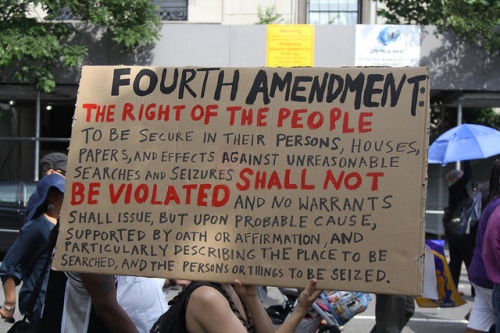
The Fourth Amendment guards against searches, arrests, and seizures of property without a specific warrant or a “probable cause” to believe a crime has been committed. Some rights to privacy have been found in this amendment and others by the Supreme Court. Including Medical Records!
NRA SuperPac Weapons Industry has ruled America for decades along with supporting industries.

~~~~ NRA Disinformation ~~~~
POLITIFACT says they are full of Sh**

So, I guess it boils down to which Constitutional Amendment you want to tread on … Our Founding Fathers lived in an era of adventure and discovery and quest for common sense that allowed freedoms most Europeans were not privileged to have. Most early settlers were hired to work off their debts and sent into a great unknown land to make profits for those back on the continent. Pioneers were responsible for their own security and had to hunt for their meals. Today that scenario is a quaint memory. America is divided between Urban and Rural realities. But, even the Rural reality does not expect the individual to kill it’s own meal or fight off Indians and bandits without assistance. Today’s criminal is more sophisticated and personal safety has to play catch up. The only criminals who resort to violence are those uneducated or mentally deficient enough to have missed out on computer crimes that rake in the big bucks.Violent criminals are desperate for some reason … lack of drugs whether legal or illegal, usually pushes them over the edge. So, if you want to wag your finger at the culprits for the social and psychological meltdown of American Culture, look at both the Drug Industry and the Weapons Industry and their GIANT lobbies who fund our Congress and Senate campaigns.
Republicans Are The Apocalypse
This is what met me this morning on 122112

I thought the world was on fire. But on closer look, I realized it was a beautiful sunrise.
I have decided that the end of the world, at least for Americans and global economies, must be the Republican loyalty to that demon of social consciousness … Grover Norquist and his henchmen from the Tea Party.
Lock and Load, Twist and Shoot – Update
Lock and Load, Twist and Shoot

In November 15th, 2011 I commented about the Gabriel Giffords shooting. Since then a lot has happened … In a massacre so vicious it left a President in tears, 20 young children, six adults and a shooter are dead in Newtown, Connecticut following the second-deadliest school attack in U.S. history. Read more in the full story.
It does not help matters that the killer’s mother was a Doomsday Prepper. This would explain the “what-the-hell” attitude that killing as many people as I can, because the world will end anyway …
There have been numerous mass shootings since November 2011, when this article was originally written and posted on BlueBloggin
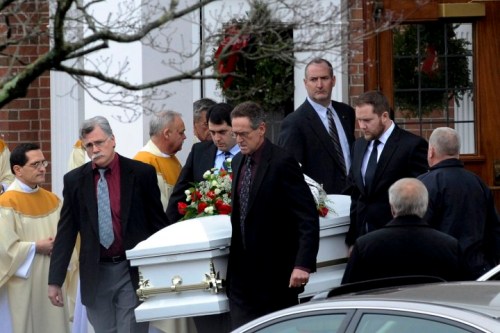 The tragedy of shooting up an elementary school, with war weapons borrowed from a murdered parent, has changed everything! On top of all this, sickness still pours onto America’s grief. Again, without regard to the pain the majority of us are feeling, Westboro Church has decided to pour salt into our wounds. Their nasty rhetoric has my ire! In my own sadness, HATE is not acceptable, and I refuse to comply with HATE of my own. I do NOT hate anyone or anything. I am filled with disgust and sadness that there are still sick people walk freely among us and hurt other people. To quote America’s President, “We can’t tolerate this anymore,” and Senators Mark Warner and Robert Menendez and Newtown residents, all say ‘enough is enough’ after tragedy. “Seeing the massacre of so many innocent children has changed everything,” Senator Joe Manchin said, “Everything has to be on the table.”
“enough is enough”
Today: Westboro Baptist Church, the tiny independent fundamentalist Christian church based in Topeka, Kan., announced on Twitter that, once again, they are planning to stomp over our nation’s heartache by protesting at the funerals of the victims of the Sandy Hook Elementary School shooting and declaring “God sent the shooter.” How do you solve a problem like Westboro Baptist Church?
“enough is enough”
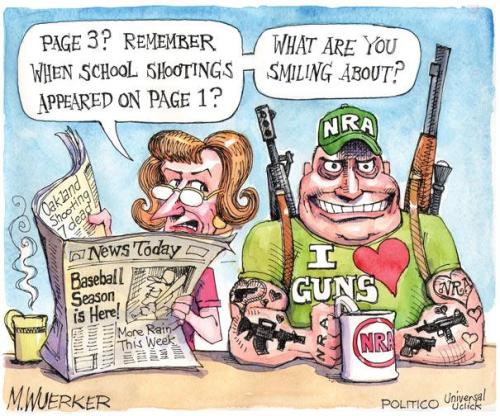
Thank you Politico and M. Wuerker, for this depiction of … the opinion divide.
Below is my original article from November of last year. What I said then still applies today … many mass shootings later.
If no one speaks up soon, every criminal and crazy will come to the gun shows to get the tools of their trade. Legally. The Gun Debate is so twisted that the issue is totally missed. The laws being presented do not take my gun away. That is because I am not diagnosed with a mental impairment nor have I committed a crime.
Here is the Debate from the New York Times:
Taking, and Restoring, the Rights of Felons and Misinterpreting the Right to Bear Arms
Felons Finding It Easy to Regain Gun Rights This gradual pulling back of what many Americans have unquestioningly assumed was a blanket prohibition has drawn relatively little public notice. Indeed, state law enforcement agencies have scant information, if any, on which felons are getting their gun rights back, let alone how many have gone on to commit new crimes.
While many states continue to make it very difficult for felons to get their gun rights back — and federal felons are out of luck without a presidential pardon — many other jurisdictions are far more lenient, The Times found. In some, restoration is automatic for nonviolent felons as soon as they complete their sentences. In others, the decision is left up to judges, but the standards are generally vague, the process often perfunctory. In some states, even violent felons face a relatively low bar, with no waiting period before they can apply.
Here is the debate from: Handgunlaw.us:
Gun SALES UP 2.6%, WHILE GUN CRIMES DOWN 2.4%. . . New statistics show that firearm and ammunition sales are on the rise, coinciding with steady downward trends in gun crime, suicide and accident rates in the U.S. The National Shooting Sports Foundation has released U.S. Dept. of the Treasury figures indicating that 2005 retail sales of firearms and ammunition rose 2.6 percent for a total volume of $2.1 billion. For the year, approximately 4.7 million new guns were sold, bringing the estimated number of citizen-owned firearms in the U.S. to more than 290 million. The number of American households with at least one firearm is now estimated at nearly 110 million.
Of the various firearm types, the sharpest gains were seen in retail sales of handguns (pistols and revolvers). Handgun sales rose 3 percent while long-gun (rifle and shotgun) sales rose 1.8 percent. Ammunition sales rose 3.5 percent.15 November 2011 Gun News Headlines Grassley fires broadside at Eric Holder, DOJ subordinates. False alarms over national CCW legislation only helps anti-gunners. On the other hand, gun reciprocity shoots holes in states’ rights. Carrying concealed weapons just keeps getting easier. Big consequences for even small crimes. Disarming Afghan politicians….
14 November 2011 Gun News Headlines A look at Newt Gingrich. From GOA “A” rating to “D”. Little known colonial pamphlet tells us about the Constitution and Second Amendment. The eloquence of…
12 November 2011 Gun News Headlines Showdown looming on national concealed carry. Nation needs right to carry reciprocity. Grassley stays on point about falsehoods from DOJ. ‘Furious’ excuse…
Today’s related NEWS:
Chair: House to strip Senate add-ons from repeat offender bill… act this week on legislation to restrict parole eligibility for habitual, … by the Senate that make sweeping changes to sentencing, drug and gun laws. …
Concealed gun carry cut from House gun bill… another state — loosening DC gun laws in the process — did not pass a final hurdle on Monday night before major gun legislation reaches the House floor. …
Editorial: Gun reciprocity shoots holes in states’ rights? USA Today
Carrying concealed weapons just keeps getting easier? iWatch News
House to consider national concealed carry gun bill Tuesday? Daily CallerLocal handgun sales show steady increase in wake new law Matt Robinson/Press-Gazette correspondent Handgun sales are steadily rising since the state’s concealed carry law took effect earlier this month, …
Knuckleheads and Worse, Bringing Guns in Carry-ons That, it says, is “for the law-enforcement officer to decide.” And I should note an exception to all this. Travelers can carry guns — but only unloaded and …
Increasing US Gun Permit Checks And Relaxed Concealed Carry Laws …
In January this year: CNN Poll: No change on gun law opinions after Arizona shootingsWashington (CNN) – Americans’ overall attitudes toward gun laws have not budged an inch in the wake of the shootings in Arizona, according to a new national poll.
On Nov 14, this year from The Telegraph, UK: Gabrielle Giffords shooting: Why it is time to change gun laws The comments following this article are too enlightening.

Is your radical sub conscious desire to have an armed crazy break in to your home, just so you can blast them to smithereens? And, of course, that would, no doubt, prove your point, if you survived. You have defended your sacred home against the evil out there. You are the hero of your neighborhood. The alien invaders are trembling in their extra terrestrial boots. You can own a small arsenal, but if the government really thinks you are a threat, they bring in the gun ships and blow a hole in the earth where your arsenal used to be.
I have my personal reasons for owning a gun, but they are not to threaten the government, commit a crime or kill animals. It alarms me that my fellow gun owners are so way out of control on this topic. The NRA has done an exemplary job of switching the debate to the Constitutional Rights of citizens … That’s all well and good. The Founding Fathers were not faced with an overcrowded society with rampant mental illness and drug induced aggression. You don’t give a crack head a gun. You don’t give a convicted criminal a gun. That’s the bottom line. It is so easy to influence the mentally unstable public, that any restrictions to legally owning a gun is unconstitutional. Bull Shit! Granted the mentally ill and felons have most of their constitutional rights intact. But, if Charles Manson were paroled today I don’t want him to seek out the first Gun Show and buy a .357 Magnum or an AK-47. I don’t want him sitting next to me on a plane, either … bad me. I don’t want some revenge motivated deluded nut case shooting up a school, mall or political rally, either. Bless the incredible Gabrielle Giffords for surviving this disaster.
Time to arm the Democrats, the Tea Partiers are itching for a showdown …maybe they will be less enthusiastic if it is a fair fight. Of course, if a responsible law was passed, and we all abide by it, how many Tea Partiers would qualify for a permit?

Party on Rick Perry!!!!! Did you see that kid in the tree????
November 15th, 2011 | Category: 2nd Amendment, concealed weapons, Gun Laws, Politics | Subscribe to comments | Leave a comment | Trackback URL | Edit



 TruthHugger